Sale!
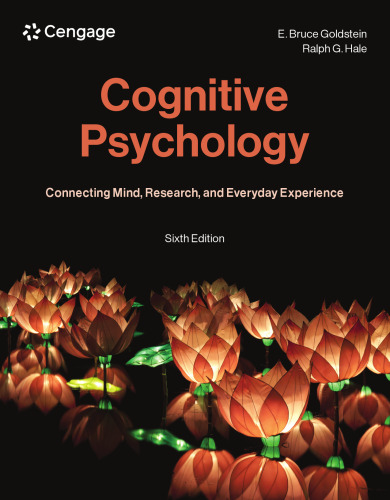
Cognitive Psychology: Connecting Mind, Research, and Everyday Experience 6th Edition by E. Bruce Goldstein, ISBN-13: 978-8214143386
$100.00 Original price was: $100.00.$24.99Current price is: $24.99.
Description
NOTE: This book is a standalone book and will NOT include any access codes.
[PDF eBook eTextbook] – Available Instantly
- Publisher : Cengage Learning
- Publication date : January 10, 2025
- Edition : 6th
- Language : English
- 528 pages
- ISBN-10 : 8214143381
- ISBN-13 : 978-8214143386
A lot goes on in your head when you’re doing something simple like remembering (or forgetting!) to do your next assignment. Goldstein’s COGNITIVE PSYCHOLOGY: CONNECTING MIND, RESEARCH, AND EVERYDAY EXPERIENCE, 6th Edition, explains all the activity going on in your mind. Concrete examples and illustrations help you understand both the scientific importance of theories and their relevance to you, including research-based suggestions for better ways to study.
Table of Contents:
Cover Page
Title Page
Copyright Page
CogLab Experiments
Demonstrations
Methods
Preface to Instructors
Preface to Students
About the Authors
Acknowledgments
1. Introduction to Cognitive Psychology
1.1. Cognitive Psychology: Studying the Mind
What Is the Mind?
1.2. Studying the Mind: Early Work in Cognitive Psychology
Donders’s Pioneering Experiment: How Long Does It Take to Make a Decision?
1.3. Abandoning the Study of the Mind
Watson Founds Behaviorism
Skinner’s Operant Conditioning
Setting the Stage for the Reemergence of the Mind in Psychology
1.4. The Rebirth of the Study of the Mind
Paradigms and Paradigm Shifts
Introduction of the Digital Computer
Conferences on Artificial Intelligence and Information Theory
The Cognitive “Revolution” Took a While
1.5. The Evolution of Cognitive Psychology
What Neisser Wrote
Studying Higher Mental Processes
Studying the Physiology of Cognition
New Perspectives on Behavior
Chapter 1 Summary
Think About It
2. Cognitive Neuroscience
2.1. Levels of Analysis
2.2. Neurons: Basic Principles
Early Conceptions of Neurons
Signals That Travel in Neurons
2.3. Representation by Neural Firing
The Story of Neural Representation and Cognition: A Preview
Feature Detectors
Neurons That Respond to Complex Stimuli
Sensory Coding
2.4. Localized Representation
Localization Determined by Neuropsychology
Localization Determined by Recording from Neurons
Localization Demonstrated by Brain Imaging
2.5. Distributed Representation
Looking at a Face
Remembering
Producing and Understanding Language
2.6. Neural Networks
Structural Connectivity
Functional Connectivity
The Dynamics of Cognition
The Default Mode Network
Summary
Think About It
3. Perception
3.1. The Nature of Perception
Some Basic Characteristics of Perception
A Human Perceives Objects and a Scene
A Computer-Vision System Perceives Objects and a Scene
3.2. Why Is It So Difficult to Design a Perceiving Machine?
The Stimulus on the Receptors Is Ambiguous
Objects Can Be Partially Hidden or Blurred
Objects Look Different from Different Viewpoints
Scenes Contain High-Level Information
3.3. Information for Human Perception
Perceiving Objects
Hearing Words in a Sentence
3.4. Conceptions of Object Perception
Helmholtz’s Theory of Unconscious Inference
The Gestalt Principles of Organization
Taking Regularities of the Environment into Account
Bayesian Inference
Comparing the Four Approaches
3.5. Neurons and Knowledge About the Environment
Neurons That Respond to Horizontals and Verticals
Experience-Dependent Plasticity
3.6. Perception and Action: Behavior
Movement Facilitates Perception
The Interaction of Perception and Action
3.7. Perception and Action: Physiology
What and Where Streams
Perception and Action Streams
Mirror Neurons
Summary
Think About It
4. Attention
4.1. Attention as Information Processing
Broadbent’s Filter Model of Attention
Modifying Broadbent’s Model: More Early Selection Models
A Late Selection Model
4.2. Processing Capacity and Perceptual Load
4.3. Directing Attention by Scanning a Scene
Scanning a Scene with Eye Movements
Scanning Based on Stimulus Salience
Scanning Based on Cognitive Factors
Scanning Based on Task Demands
4.4. Outcomes of Attention
Attention Improves Our Ability to Respond to a Location
Attention Improves Our Ability to Respond to Objects
Attention Affects Perception
Attention Affects Physiological Responding
Attention Changes the Representation of Objects Across the Cortex
4.5. Divided Attention: Can We Attend to More Than One Thing at a Time?
Divided Attention, Task Switching, and Multitasking
Divided Attention Can Be Achieved with Practice: Automatic Processing
Divided Attention Becomes More Difficult When Tasks Are Harder
4.6. Distractions
Distractions by Cell Phones while Driving
Distractions by the Internet
Distraction Caused by Mind Wandering
4.7. What Happens When We Do Not Attend?
Inattentional Blindness
Inattentional Deafness
Change Detection
What About Everyday Experience?
4.8. Attention and Experiencing a Coherent World
Feature Integration Theory
Evidence for Feature Integration Theory
Summary
Think About It
5. Short-Term and Working Memory
5.1. The Modal Model of Memory
5.2. Sensory Memory
Persistence of Vision
Sperling’s Experiment: Measuring the Capacity and Duration of the Sensory Store
5.3. Short-Term Memory: Storage
What Is the Duration of Short-Term Memory?
How Many Items Can Be Held in Short-Term Memory?
How Much Information Can Be Held in Short-Term Memory?
5.4. Working Memory: Manipulating Information
The Phonological Loop
The Visuospatial Sketch Pad
The Central Executive
An Added Component: The Episodic Buffer
5.5. Working Memory and the Brain
The Effect of Damage to the Prefrontal Cortex
Prefrontal Neurons That Hold Information
The Neural Dynamics of Working Memory
5.6. Something to Consider: Why Is More Working Memory Better?
Summary
Think About It
6. Long-Term Memory: Structure
6.1. Comparing Short-Term and Long-Term Memory Processes
Serial Position Curve
Coding in Short-Term and Long-Term Memory
Comparing Coding in Short-Term and Long-Term Memory
Locating Memory in the Brain
6.2. Episodic and Semantic Memory
Distinctions Between Episodic and Semantic Memory
Interactions Between Episodic and Semantic Memory
What Happens to Episodic and Semantic Memories as Time Passes?
6.3. Back to the Future
6.4. Procedural Memory, Priming, and Conditioning
Procedural Memory
Priming
Classical Conditioning
Operant (or Instrumental) Conditioning
Summary
Think About It
7. Long-Term Memory: Encoding, Retrieval, and Consolidation
7.1. Encoding: Getting Information into Long-Term Memory
Levels of Processing Theory
Forming Visual Images
Linking Words to Yourself
Generating Information
Organizing Information
Relating Words to Survival Value
Retrieval Practice
7.2. Effective Studying
Elaborate
Generate and Test
Organize
Take Breaks
Avoid “Illusions of Learning”
Be An “Active” Note-Taker
7.3. Retrieval: Getting Information Out of Memory
Retrieval Cues
Matching Conditions of Encoding and Retrieval
Mnemonics
Learning Verbatim
7.4. Consolidation: Establishing Memories
Synaptic Consolidation: Experience Causes Changes at the Synapse
Systems Consolidation: The Hippocampus and the Cortex
Consolidation and Sleep: Enhancing Memory
7.5. Reconsolidation: The Dynamics of Memory
Reconsolidation: A Famous Rat Experiment
Reconsolidation in Humans
A Practical Outcome of Reconsolidation Research
7.6. Something to Consider: Alternative Explanations in Cognitive Psychology
Summary
Think About It
8. Everyday Memory and Memory Errors
8.1. The Journey So Far
Your Brain Is Not a Recording Device
8.2. Autobiographical Memory: What Has Happened in My Life
The Multidimensional Nature of Autobiographical Memory
Memory Over the Life Span
8.3. Memory for “Exceptional” Events
Memory and Emotion
Flashbulb Memories
Music- and Odor-Elicited Autobiographical Memories
8.4. The Constructive Nature of Memory
Source Monitoring Errors
The Illusory Truth Effect
How Real-World Knowledge Affects Memory
8.5. The Misinformation Effect
8.6. Creating Memories for Events in People’s Lives
Infantile Amnesia
Creating Childhood Memories
Legal Implications of False Memory Research
8.7. Why Do People Make Errors in Eyewitness Testimony?
Errors of Eyewitness Identification
Errors Associated with Perception and Attention
Perception and Eyewitness Testimony: The Case of Francisco Carrillo
Misidentifications Due to Familiarity
Errors Due to Suggestion
What Is Being Done to Improve Eyewitness Testimony?
Eliciting False Confessions
Memory Deficits: Going Beyond Typical and Expected Memory Loss
What Is It Like to Have “Exceptional” Memory?
Summary
Think About It
9. Conceptual Knowledge
9.1. Basic Properties of Concepts and Categories
How Objects Are Placed in Categories
9.2. Is There a Psychologically “Basic” Level of Categories?
Rosch’s Approach: What’s Special About Basic Level Categories?
9.3. Network Models of Categorization
Representing Relationships Among Categories: Semantic Networks
The Connectionist Approach
9.4. How Concepts Are Represented in the Brain
Four Proposals About How Concepts Are Represented in the Brain
Summary
Think About It
10. Visual Imagery
10.1. Imagery in the History of Psychology
Early Ideas About Imagery
The Imagery Debate: How is Information Mentally Represented?
Propositional or Depictive?
Imagery and the Cognitive Revolution
10.2. Imagery and Perception: Do They Share the Same Mechanisms?
Kosslyn’s Mental Scanning Experiments
Comparing Imagery and Perception
10.3. Imagery and the Brain
Imagery Neurons in the Human Brain
Brain Imaging
Multivoxel Pattern Analysis
Transcranial Magnetic Stimulation
Neuropsychological Case Studies
Conclusions from the Imagery Debate
10.4. Individual Differences in Visual Imagery
Aphantasia
Why Should We Care About Mental Imagery?
Summary
Think About It
11. Language
11.1. What Is Language?
Are Humans the Only Animals with Language?
The Creativity of Human Language
The Hierarchical Nature of Language
The Universal Need to Communicate with Language
Revisiting the Imagery Debate: Vision and Language
Studying Language
11.2. Understanding Words: A Few Complications
Not All Words Are Created Equal: Differences in Frequency
The Pronunciation of Words Is Variable
There Are No Silences Between Words in Normal Conversation
11.3. Understanding Ambiguous Words
Accessing Multiple Meanings
Frequency Influences Which Meanings Are Activated
Semantic Satiation
11.4. Understanding Sentences
Parsing: Making Sense of Sentences
The Garden Path Model of Parsing
The Constraint-Based Approach to Parsing
Prediction, Prediction, Prediction . . .
11.5. Understanding Text and Stories
Making Inferences
Situation Models
11.6. Having Conversations
The Given–New Contract
Common Ground: Taking the Other Person into Account
Establishing Common Ground
Syntactic Coordination
Bilingualism and Multilingualism
Cognitive Advantages of Bilingualism
Cognitive Disadvantages of Bilingualism
Disfluencies: Errors in Speech or Language Tools?
Summary
Think About It
12. Problem-Solving and Creativity
12.1. What Is a Problem?
12.2. The Gestalt Approach
Representing a Problem in the Mind
The Idea of Insight
Functional Fixedness and Mental Set
12.3. The Information-Processing Approach
Newell and Simon’s Approach
The Importance of How a Problem Is Stated
12.4. Using Analogies to Solve Problems
Analogical Transfer
Analogical Encoding
Analogy in the Real World
12.5. How Experts Solve Problems
Differences Between How Experts and Novices Solve Problems
Expertise Is Only an Advantage in the Expert’s Specialty
12.6. Creative Problem-Solving
What Is Creativity?
Practical Creativity
Generating Ideas
12.7. Creativity and the Brain
Opening the Mind to Think “Outside the Box”
Brain “Preparation” for Insight and Analytical Problem-Solving
Networks Associated with Creativity
Solitude
Mindfulness
Summary
Think About It
13. Judgment, Decisions, and Reasoning
13.1. Inductive Reasoning: Making Judgments from Observations
The Availability Heuristic
The Representativeness Heuristic
Making Judgments Without Considering the Conjunction Rule
Attitudes Can Affect Judgment
Evaluating False Evidence
13.2. Deductive Reasoning: Syllogisms and Logic
Categorical Syllogisms
Mental Models of Deductive Reasoning
Conditional Syllogisms
Conditional Reasoning: The Wason Four-Card Problem
13.3. Decision-Making: Choosing Among Alternatives
The Utility Approach to Decisions
How Emotions Affect Decisions
Decisions Can Depend on the Context Within Which They Are Made
Decisions Can Depend on How Choices Are Presented
Neuroeconomics: The Neural Basis of Decision-making
Summary
Think About It
References
E. Bruce Goldstein is associate professor emeritus of Psychology at the University of Pittsburgh and adjunct professor of psychology at the University of Arizona. He has received the Chancellor’s Distinguished Teaching Award from the University of Pittsburgh for his classroom teaching and textbook writing. He received his Bachelor’s degree in Chemical Engineering from Tufts University and his PhD in Experimental Psychology from Brown University. He was a postdoctoral fellow in the biology department at Harvard University before joining the faculty at the University of Pittsburgh. Bruce published papers on a wide variety of topics, including retinal and cortical physiology, visual attention and the perception of pictures before focusing exclusively on teaching (Sensation and Perception, Cognitive Psychology, Psychology of Art and Introductory Psychology) and writing textbooks. He is the co-author of SENSATION AND PERCEPTION, 11th Edition (Cengage, 2021), and editor of the BLACKWELL HANDBOOK OF PERCEPTION (Blackwell, 2001) as well as the two-volume SAGE ENCYCLOPEDIA OF PERCEPTION (Sage, 2010). In 2016, he won “The Flame Challenge” competition, sponsored by the Alan Alda Center for Communicating Science, for his essay written for 11-year-olds on What Is Sound?
Ralph G. Hale is Associate Professor of Psychological Science at the University of North Georgia. He earned his Ph.D. in psychology from the University of Georgia in 2018, specializing in visual perception. He also earned two certifications in interdisciplinary university teaching, one from the University of Georgia in 2018 and another from the Association of College and University Educators in 2024. He is dedicated to undergraduate education and teaches a wide variety of psychology courses including cognitive psychology, memory, biopsychology, psychology of visual art, research methods, behavioral statistics, and senior psychology seminar. He has been recognized by his university for his commitment to quality education, winning the Teaching Excellence Award for Tenured Faculty in 2020 and the Ann Matthews Purdy Outstanding Teacher of the Year Award in 2023. He is also dedicated to scholarship, with an emphasis on undergraduate research. His areas of expertise are visual perception and memory with interests in visual aesthetics, errors in visual memory, and visual illusions. As principal investigator of the Hale Vision Lab, he mentors students through projects leading to conference presentations and publications. Recently he has published papers related to color spreading illusions, social gaze, and various cognitive effects. In 2023, he won his university’s Excellence in Undergraduate Research Award in recognition of his scholarly mentorship. He asserts that undergraduate mentorship is the focal point of his academic career, from which all other aspects radiate. His venture into book writing is an extension of this commitment to mentorship, as quality textbooks and resources are fundamental to educational success.
What makes us different?
• Instant Download
• Always Competitive Pricing
• 100% Privacy
• FREE Sample Available
• 24-7 LIVE Customer Support